
CalibrAI VaultAI-Powered PDF Remediation, Built for Compliance
CalibrAI Vault transforms scanned and native PDFs into validated, tagged, standards-conformant documents at machine speed, without migrating content or changing existing workflows.
Key capabilities
Analyzes complex layouts and establishes the correct reading sequence across columns, tables, lists, page breaks, running heads, and repeated content.
Reading Order and Page Continuity

Intelligent Document Structuring
Applies OCR, artifact identification, content cleanup, and granular semantic tagging based on the document type and structure.

Generates context-aware descriptions for photographs, charts, diagrams, and equations while preserving accessible mathematical meaning.
Alt Text and Math Accessibility
Ingests documents through a web app, API, or storage connector and returns remediated output with a report detailing what was checked, corrected, and outstanding.
Automated Validation and Delivery
ComplianceWCAG 2.1 Level AA
PDF/UA (ISO 14289)
Section 508
EN 301 549
ADA Title II
EPUB Accessibility 1.1 (ISO/IEC 23761)
OutputsPDF/UA: validated, standards-conformant tagged PDF
XML: structured content for downstream systems
HTML: accessible web-ready content
EPUB: accessible digital-publication output
Conformance report: validation results, corrections, and outstanding items
Make Every Image Accessible. Enhance Inclusivity with AI.
Codemantra Alt Text helps organizations meet accessibility standards by automatically generating accurate, meaningful alternative text for images, charts, and graphics. Powered by advanced AI and human validation, it ensures compliance, improves content discoverability, and delivers an inclusive reading experience for all audiences.
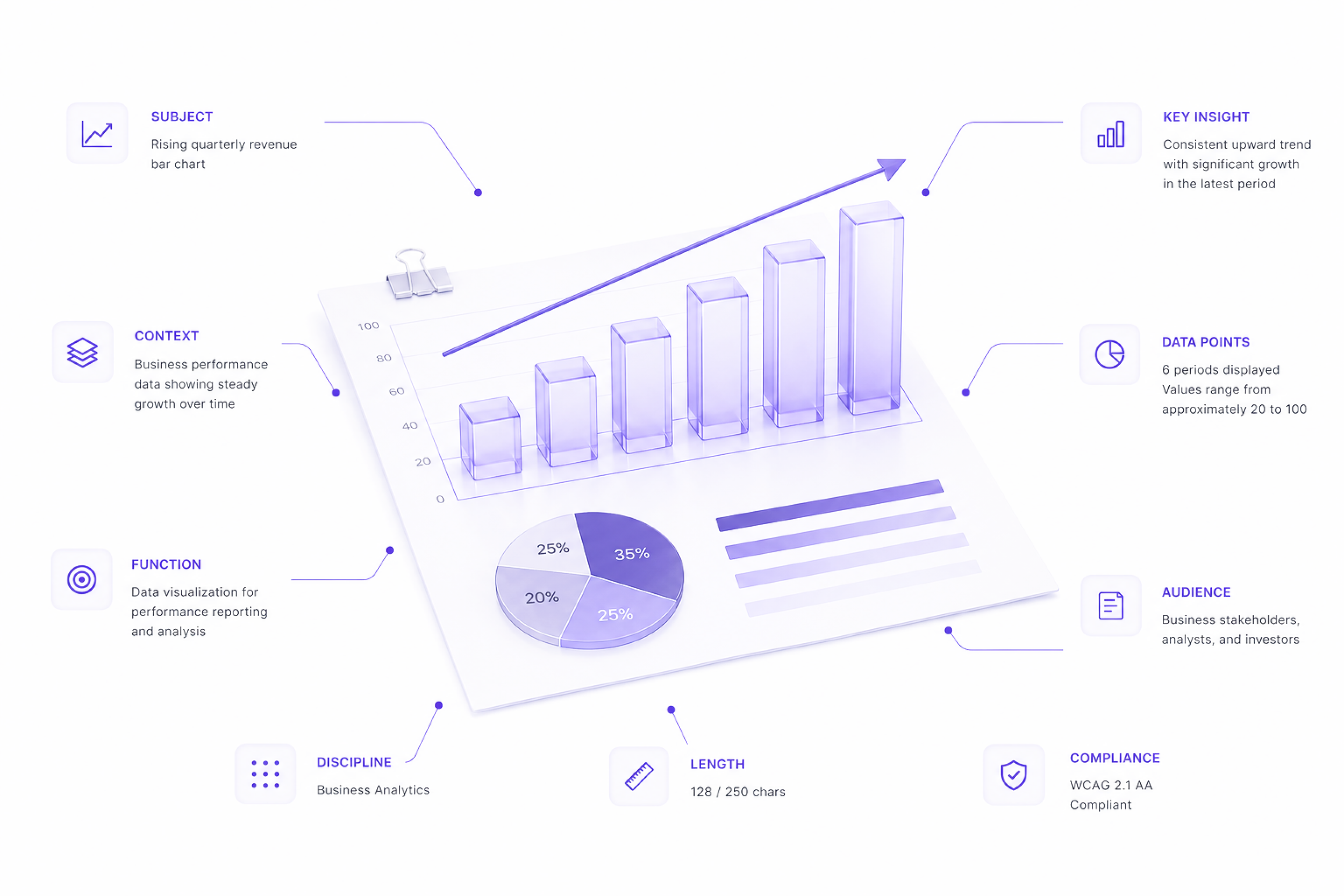
Alt Text AIWCAG-Compliant Image Descriptions at Scale
Alt Text AI generates context-aware, compliance-grade alternative text for complex scientific, technical, and medical imagery, automatically, at batch volume.
Key capabilities
Simple (short), Medium (long), and Complex (long) tiers automatically assigned based on image type taxonomy.
Tiered Framework

Every description is verified across four pillars: Structural Accuracy, Domain Accuracy, Completeness, and Relevancy before delivery.
Quality Score Gate

Programmatic filters prevent speculative claims, subjective commentary, or answer-revealing text in educational content.
Hallucination Guardrails

Generates compliant alt text across English, French, German, Spanish, and additional languages.
Multi-Language Engine
OutputsSpreadsheet and JSON mapped to localized image thumbnails
Direct sync to existing content repositories
ComplianceAmericans with Disabilities Act (ADA)
European Accessibility Act (EAA)
MediA AICaptions and Audio Descriptions, Built for Compliance
Media AI automates the generation of closed captions and audio descriptions for video content, built strictly on global media accessibility standards.
Key capabilities
Precise speech-to-text with non-speech acoustic data, speaker tokenization, and structural formatting. Maximum two-line layout with intelligent line breaks.
Closed Captioning

Timed scripts voiced via screen reader technology, dynamically adapting contextual density around dialogue cues.
Audio Descriptions

Speaker change identification, ambient sound markers, smart punctuation, hyphenation for stuttering, and numerical syntax rules applied automatically.
Context-Aware Mechanics
Output FormatsWebVTT: platform delivery standard
TTML: validated schema for authoring
SRT: universal compatibility format
TXT: untimed compliance record
ComplianceW3C media accessibility standards
Under 15-frame boundary alignment for optimal caption pacing
Structure AIPDF to Accessible ePub3, Automatically
Structure AI bridges the gap between static PDF layouts and dynamic web standards, automatically zoning document layouts, mapping semantic HTML5 tags, and converting complex PDFs into clean, accessible ePub3.
Key capabilities
Automated Layout Parsing
AI engine maps document topology, defines layout zones, and predicts semantic HTML tags with a single ingest.

Advanced Table Reconstruction
Graphically defines table bounds, aligns rows and columns, assigns semantic headers, and handles colspan merges with precision traditional OCR cannot match.
Intelligent Reading Order
Auto-order for single-column text, column-wise sequencing for double-column scientific layouts, with toggle verification.

Logical Text Continuity
Continue Attribute flag binds paragraphs, lists, and tables spanning physical page breaks into uninterrupted accessible sequences.
Best ForAcademic monographs and textbooks
Scientific and technical publications
Legacy backlist conversion at scale
Outputs
Semantically clean HTML5 / accessible ePub3
Fully zoned, tag-mapped document structure ready for digital delivery
Editorial AIPublication-ready Manuscripts, End to End
Editorial AI uses an advanced agentic framework to automate mechanical, stylistic, and structural editing across the full manuscript lifecycle, delivering absolute precision with clear track changes.
Key capabilities
Corrects structural, bibliographic, and template formatting before copyediting begins, including front matter integrity, heading casing, citation validation, and numeral normalization.
Pre-editing

Deep linguistic review covering capitalization, abbreviation standards, hyphenation, dialect harmonization (US/UK), grammar verification, and scientific nomenclature.
Copyediting

Identifies citation systems (Harvard, CMS, APA, numbered), sorts groupings, enforces et al. guidelines, and flags missing or uncited references with precision error messages.
Reference Structuring

Absolute consistency across authored monographs, or chapter-level voice preservation for contributed volumes.
Configurable Scope
SupportsAuthored monographs
Contributed volumes
US and UK English dialect harmonization
OutputsPolished manuscript with embedded track changes
Categorized editorial summary report with data-driven change documentation
ASsessment AIAutomated Manuscript Review Before Production Begins
Assessment AI scans raw manuscripts and extracts comprehensive quality insights, ensuring reliability, style adherence, and completeness before any production work starts.
Key capabilities
Calculates a Final Readiness Score using syntactic accuracy, dialect profiling, and readability scoring across vocabulary density and tone.
Language Analytics

Audits for missing components, text segment drift, duplicate content, uncited float elements, and caption hierarchy gaps.
Manuscript Integrity

Processes nested folder architectures simultaneously, ideal for multi-chapter books and large content volumes.
Batch Evaluation
OutputsColor-coded diagnostic report with expandable/collapsible summary
Readiness score computed through weighted formula across grammar, structure, and vocabulary
Best ForMulti-chapter books and large batch submissions
Pre-production quality gates
Editorial readiness validation